From locked-in directions to a cloud of possibilities. Explore the changing geometry of molecular order.
μ
REAL SIMULATION ILLUSTRATIVE MATERIALS
A model, not a material prediction. Short runs can retain their starting structure. These visuals do not certify a phase transition.
Controls select saved simulations—not a live force-field calculation. Changing the diagnostic or display does not change the dynamics. Link to this selection ↗ · Theory & design ↗
Drag to rotate · charged-model arrows point −q → +q; uncharged arrows show the geometric axis · site separation/arrows enlarged for visibility, not to scale · color encodes azimuth φ · box normalized to view (check density for expansion) · sampled frames, not physical playback speed
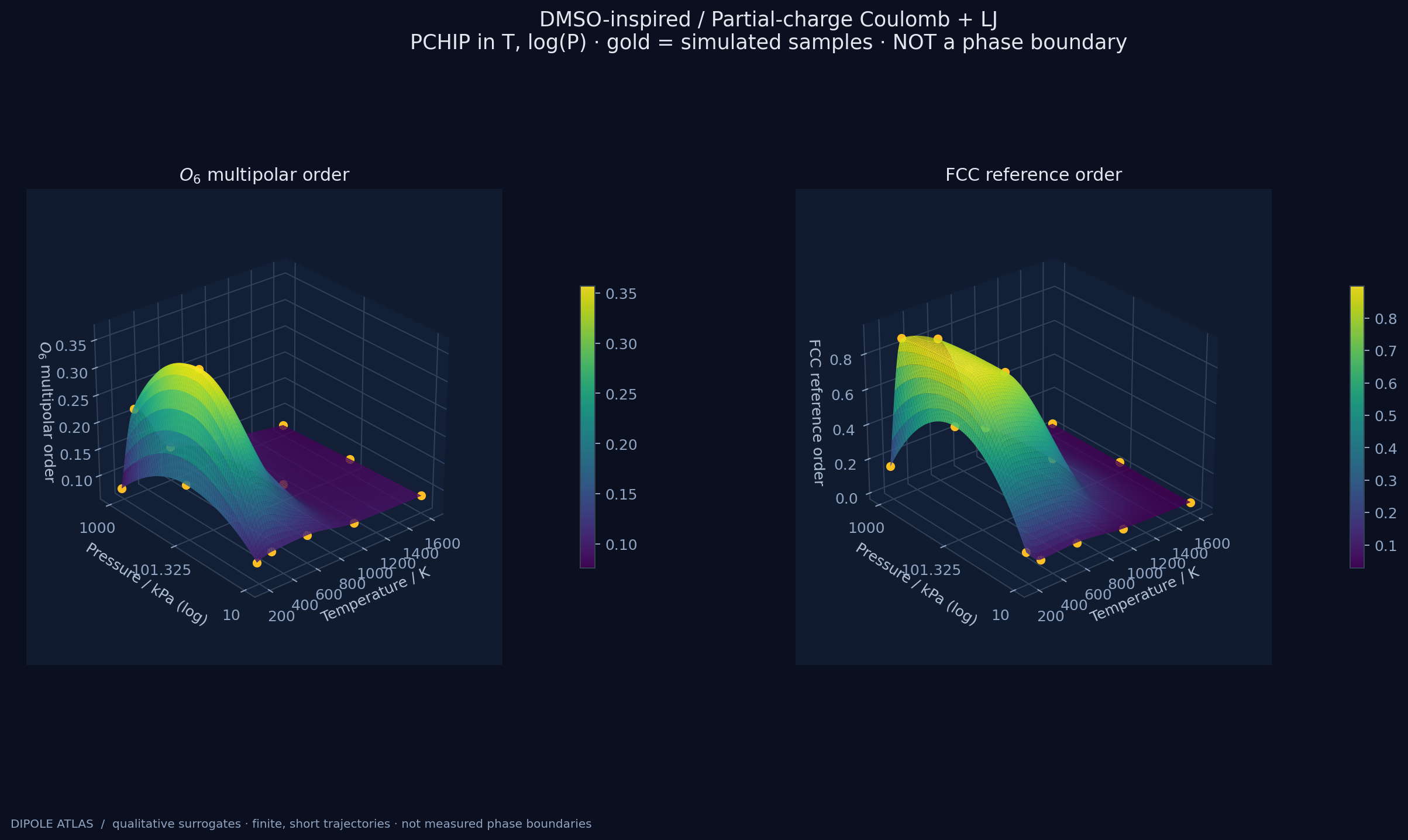
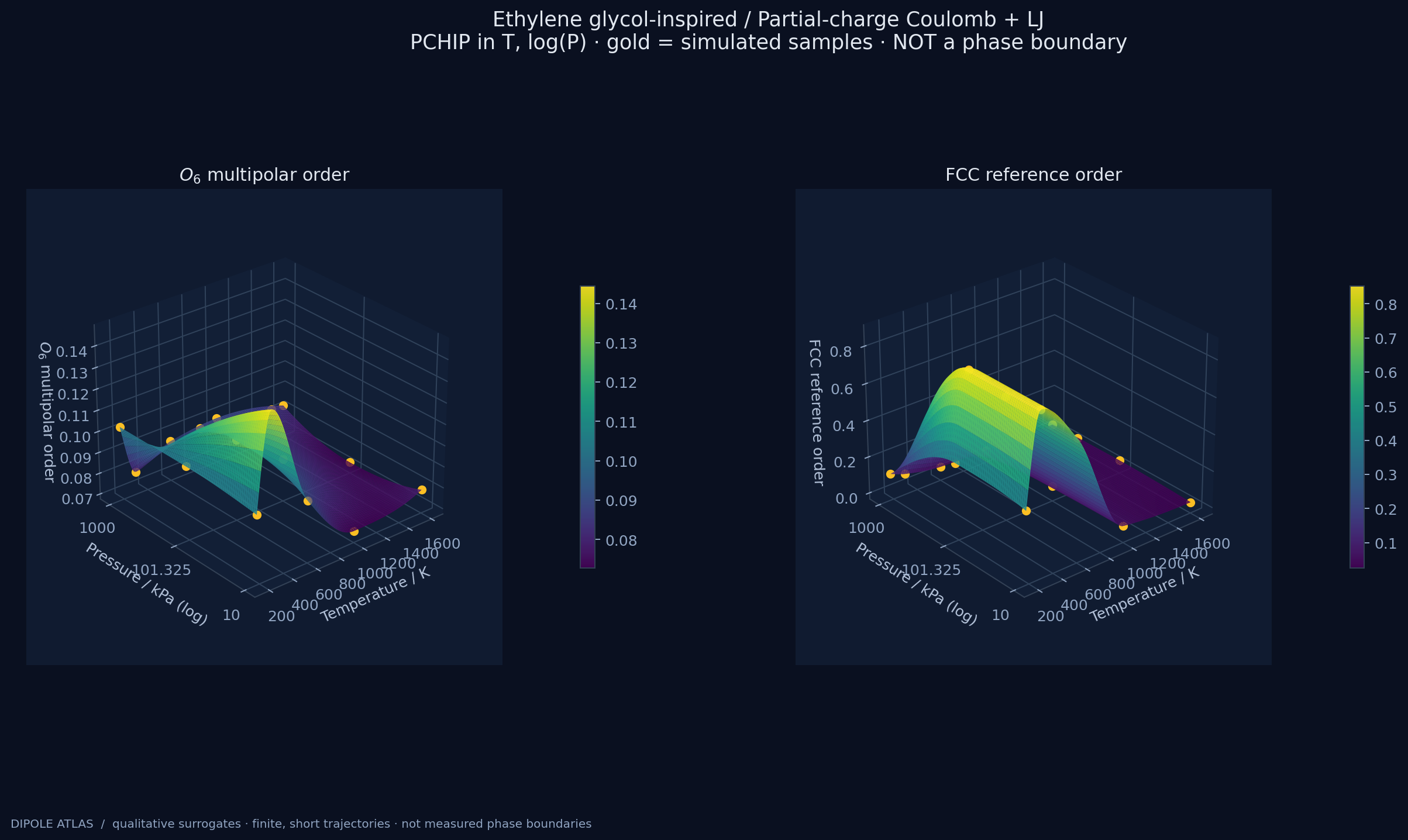
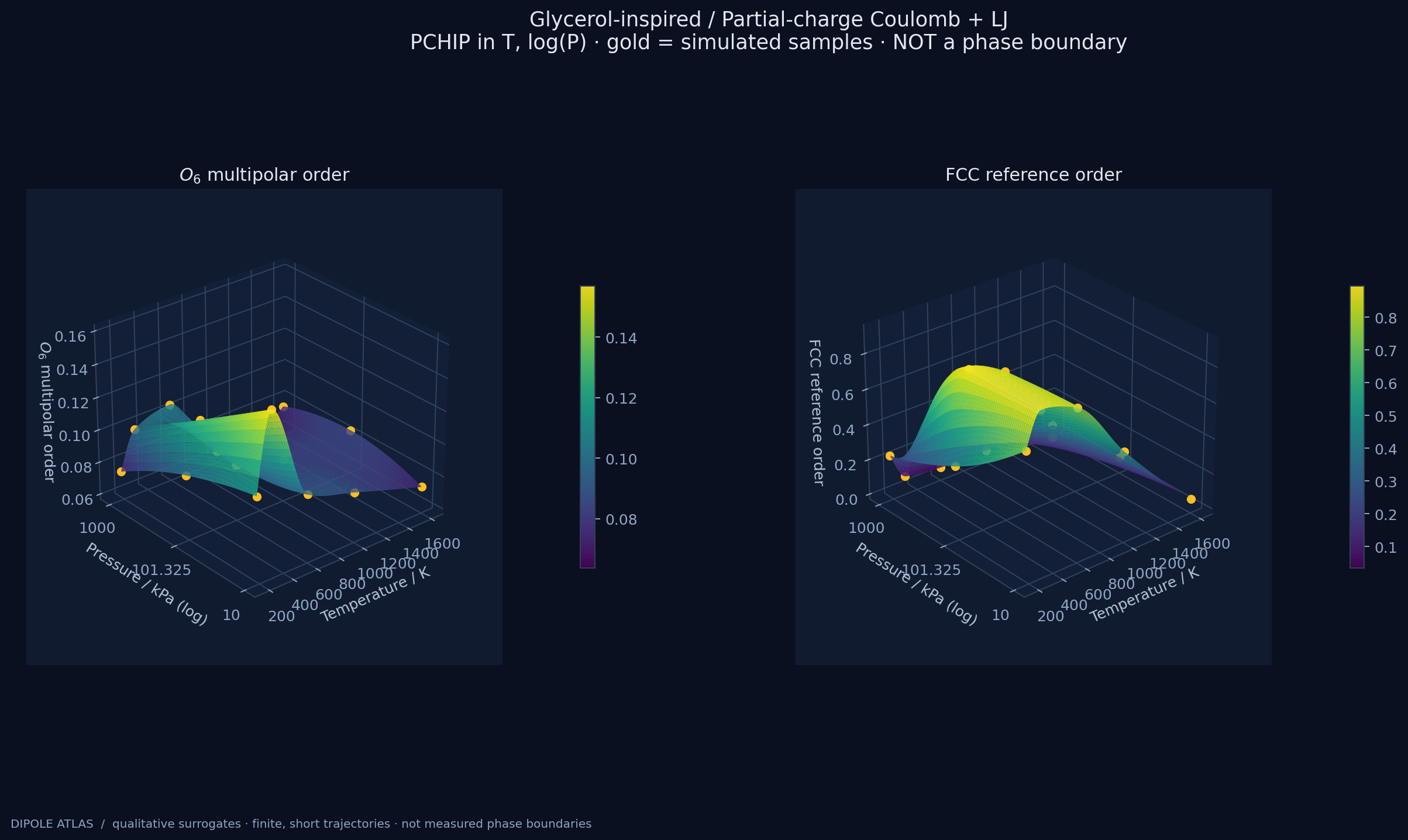
TEMPERATURE × PRESSURE
Response surface
Beyond orientation
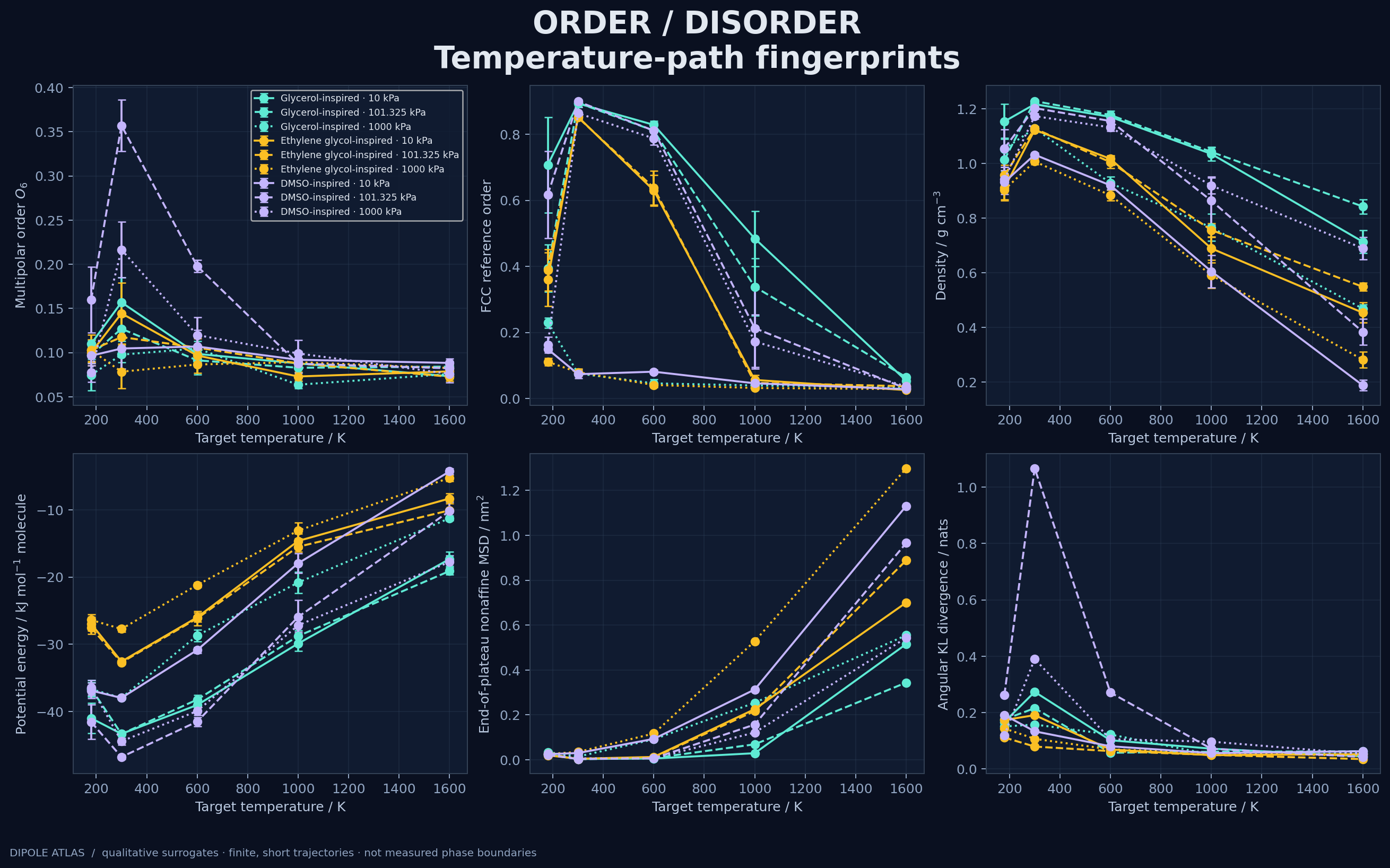
Fluctuation responses and MSD slope are exploratory estimates from short, correlated trajectories—not converged heat capacities, diffusion coefficients or transition temperatures. How to interpret them ↗
Every point comes from a simulated plateau. Error bars are exploratory block standard errors, not proof of equilibrium.
READ THE MODEL
Order is a clue, not a verdict.
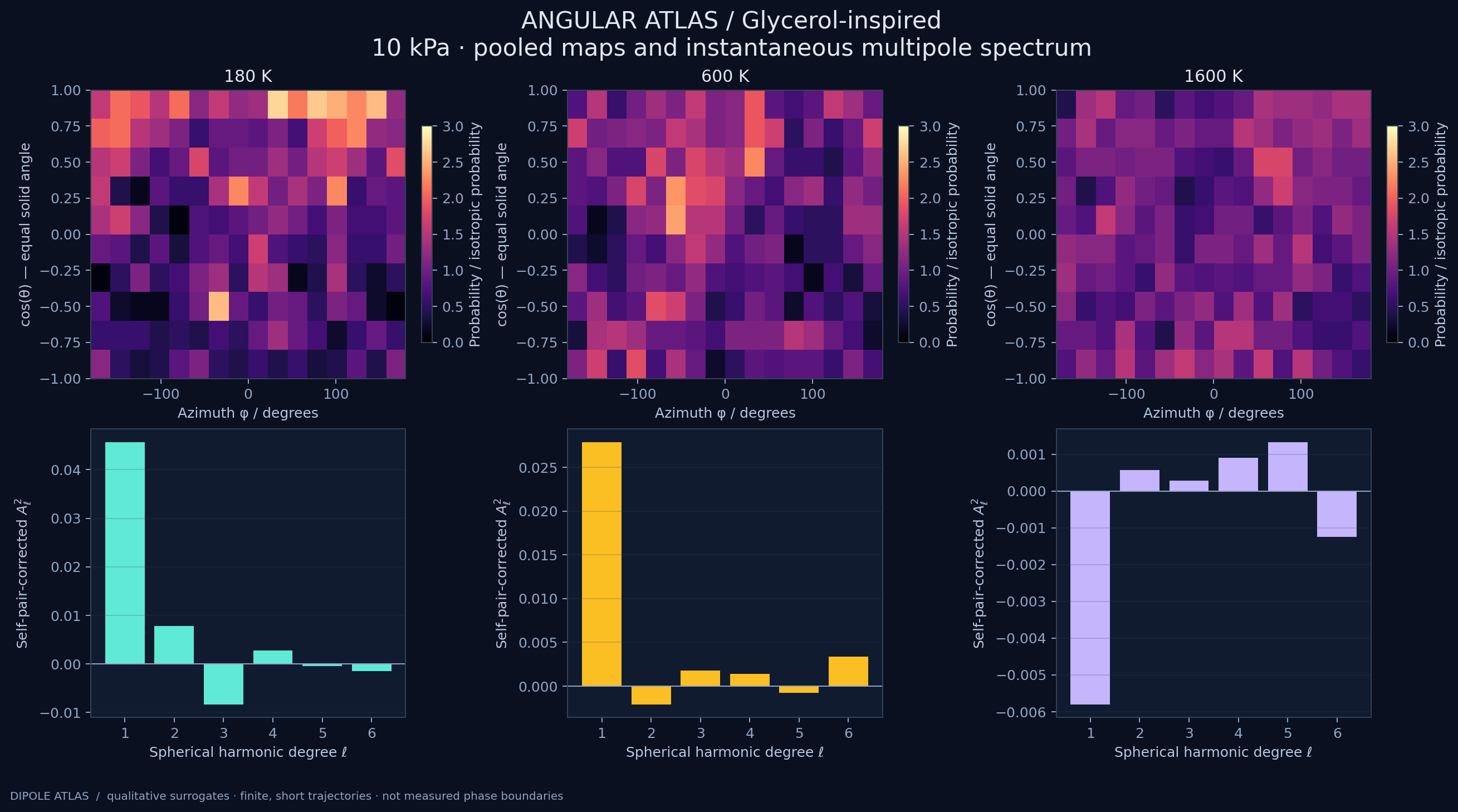
Why more than a single angle?
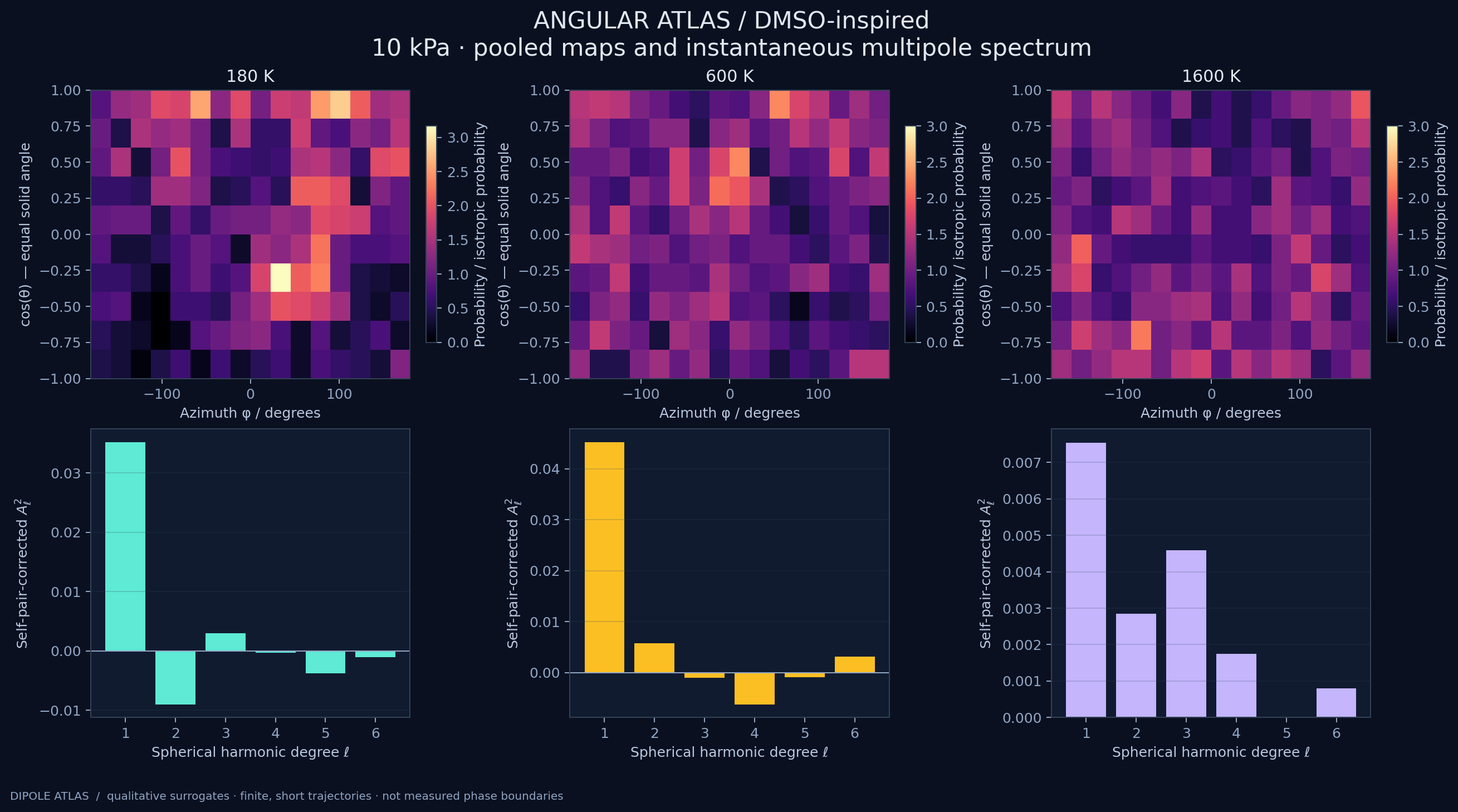
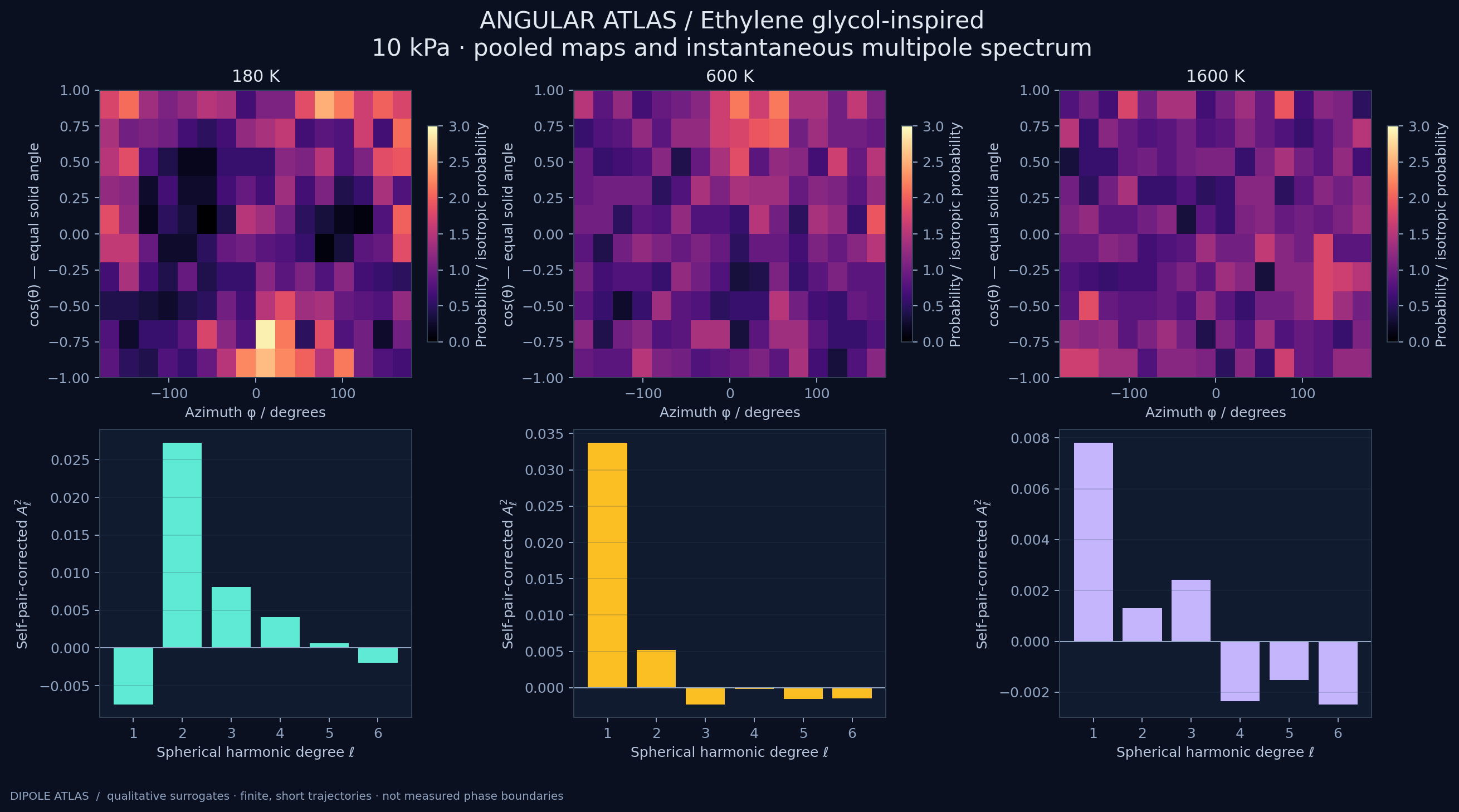
Six narrow directional populations can have almost no net polarization. We retain spherical-harmonic degrees 1–6 using pairwise Legendre polynomials. O₆ combines their positive, self-pair-corrected powers. It detects several kinds of orientational order, not an exact number of Gaussian modes.
What would suggest melting?
Loss of crystal order alongside sustained molecular displacement and a change in energy or density. A dilute state additionally needs strong density loss. Dipole disorder alone can also be a rotating solid. Short trajectories and hysteresis can be misleading.
What this run cannot claim
Qualitative two-site polar Lennard-Jones surrogates, not atomistic models of the named chemicals. Interaction scales are illustrative; hydrogen bonds, molecular flexibility, chemical reactions and decomposition are absent. Short finite periodic-box heating/cooling runs do not establish melting points, boiling points, vapour pressures or phase boundaries. High-temperature results are model behavior, not predictions for stable real molecules.
MSD removes affine box scaling and resets at each plateau. Pooled angular KL has positive finite-sample bias. The multipolar display score also has a small positive noise floor; signed spectra are retained in CSV. Browser preview is capped at 120 frames and 256 molecules per condition; full saved samples remain in the ZIP.